World War Two was a man's war. Perhaps if women had been in charge there would have no war at all. Any way....
But women did play a significant role during the war. The war production factories in America and Britain had largely women working in them. In Russia too women manned factories which churned out tanks, guns and warplanes with which Stalin's army fought the Germans. Also Russian women played a big part in the conflict zones not only as nurses but also as soldiers. Especially in Stalingrad.
Below is a photo album which shows women in WW2....
 |
Lyudmila Pavlichenko, the Russian woman sniper with 500 Germans kills under her belt.
LYUDMILA PAVLICHENKO |
Lyudmila Pavlichenko sniped a confirmed 309 Axis soldiers, including 36 German snipers, during WWII.
While most of the world shied away from putting women on the front line, the Soviet Union did not, including recruiting about 2000 women as snipers during WWII, one of which turned out to be one of the most successful snipers in history, Lyudmila Pavlichenko. She still holds the record for the highest confirmed kill total of any female sniper in history.
http://www.todayifoundout.com/i
 |
| Leni Riefenstahl, the German film maker whose "Triumph of Will" became the chief propaganda tool for the Nazis. The Economist wrote that "Triumph of the Will "sealed her reputation as the greatest female filmmaker of the 20th century |
LENI RIEFENSTAHL
Reni Liefenstahl (August 22, 1902 – September 8, 2003) was a German film director, actress and dancer widely noted for her aesthetics and innovations as a filmmaker. Her most famous film was Triumph of the Will, a documentary film made at the 1934 congress in Nuremberg of the Nazi Party. Riefenstahl’s prominence in the Third Reich, along with her personal association with Adolf Hitler, destroyed her film career following Germany's defeat in World War II, after which she was arrested but released without any charges.
 |
| With Hitler facing a soldier shortfall, women were conscripted. Here German women train in the Luftwaffe. November 1944. |
 |
| Japanese women in a ammunition factory in Japan in 1941 |
 |
| Soviet women partisans fight the Germans |
 |
Women Jewish resistance fighters captured by the Germans during the Warsaw Ghetto Uprising, 1943
.
|

 |
| Japanese soldiers surrender to the Russians in 1945 |
Lesser known about WW2 is that the Russians too attacked the Japanese. On August 9, 1945. Two days after the atom bomb was dropped on Hiroshima. It was called Operation "August Storm".
 |
| Soviet soldiers raise flag over Harbin railway station in northern China which was wrested from the Japanese |
The Soviet invasion of Manchuria began on 8 August 1945, with the Soviet invasion of the Japanese puppet states of Manchukuo and neighbouring Mengjiang; the greater offensive would eventually include northern Korea, southern Sakhalin, and the Kuril Islands. It marked the initial and only military action of the Soviet Union against the Empire of Japan; at the Yalta Conference, it had agreed to Allied pleas to terminate the neutrality pact with Japan and enter the Second World War's Pacific theatre within three months after the end of the war in Europe.
The Soviet Union had earlier in 1939 defeated the Japanese Army decisively at the Battle of Khalkhin Gol under the command of Zhukov. That was the reason that Japan did not attack Russia in 1941 and instead moved south into Asia. Otherwise Russia would have been squeezed between the Nazi Germans from the west and Japanese Army from the east. But that is another story.....
--------------------
Note handed to Naotake Sato, Japanese Ambassador to the USSR, by Soviet Foreign Minister Vyacheslav Molotov in Moscow, on August 8, 1945:
After the defeat and capitulation of Hitlerite Germany, Japan remained the only great power which still stands for the continuation of the war.
The demand of the three powers , the United States, Great Britain and China, of July 26 for the unconditional surrender of the Japanese armed forces was rejected by Japan. Thus the proposal made by the Japanese Government to the Soviet Union for mediation in the Far East has lost all foundation.
Taking into account the refusal of Japan to capitulate, the Allies approached the Soviet Government with a proposal to join the war against Japanese aggression and thus shorten the duration of the war, reduce the number of casualties and contribute toward the most speedy restoration of peace.
True to its obligation as an Ally, the Soviet Government has accepted the proposal of the Allies, and has joined in the declaration of the Allied powers of July 26.
The Soviet Government considers that this policy is the only means able to bring peace nearer, to free the people from further sacrifice and suffering and to give the Japanese people the opportunity of avoiding the danger of destruction suffered by Germany after her refusal to accept unconditional surrender.
In view of the above, the Soviet Government declares that from tomorrow, that is from August 9, the Soviet Union will consider herself in a state of war against Japan.
---------------------
 |
A Japanese soldier surrenders to the Russians in 1945
The Americans had feared that there would be a bloodbath if it sent its troops to invade the Japanese mainland; so they tried to convince Stalin that Russia too should attack Japan. At the Potsdam Conference he readily agreed. Stalin had ambitions in the Far east too. He agreed to do so three months after Germany was defeated. For Russia it was a sweet victory after the Red Army rolled into Manchuria, Port Arthur and Sakhalin Islands in 1945. It had lost Port Arthur after a humiliating defeat at the hands of Japan in 1904-5
|
 |
Japanese soldiers surrender to the Red Army in Manchuria
Many Japanese had moved to Manchuria in early 1945 to avoid the advancing Allied troops. They believed Manchuria would be safer than mainland Japan. How wrong they were!
|
 |
A Russian soldier stands guard over Japanese POWs
The Japanese army though about a million strong in Manchuria consisted of newly drafted soldiers; the elite were sent to defend the mainland. It was also short of arms and warplanes. In contrast the Russians threw in their best soldiers battle-hardened in the war against Germany. The Soviet war machine was slick and efficient sharpened in the Ostfront.
|
 |
Soviet officers interrogate Japanese generals
When the Soviet Army attacked Manchuria, a disgusted Japanese officer remarked, "It's like burglars entering an empty house."
|
 |
Russian soldiers meet American soldiers in Seoul in 1945
The Red Army men true to their tradition raped even in Manchuria. Especially men from Rokossovsky's Army. A Chinese man said disgustedly, "We thought the Russians were our allies and friends."
Many Japanese women in Manchuria were raped during and after World War II. Japanese women in Manchuria found life difficult after Soviet troops entered Manchuria near the end of the war. Many of those women were used as "dolls" -- sexual objects. There are many accounts of several Japanese women who were raped or almost raped. In one account, a young girl threw herself out a three-story window to avoid being raped by Soviet troops. Another account demonstrated how not only Soviet troops but also Chinese civilians tried to rape Japanese women. A Chinese man came to a woman's house and asked her to give him her two daughters because his daughters were raped by Japanese soldiers. The woman offered herself instead, but the man changed his mind. Japanese men offered some Japanese women as female Kamikaze troops to Soviet troops to protect their community and other Japanese women and children. Once women were raped, they were no longer part of their community and were often rejected by their husbands.
http://xpress.sfsu.edu/archives/news/001077.html
|
 |
Red Army soldiers watch a Japanese lighthouse which they burnt at Cape Kokutan, Shumshu Islands, in Kuril Islands
The last battle of WW2 was fought at Hutou, where the Japanese soldiers in their concrete bunkers fought on unaware that their country had surrendered. Hutou was subdued by the Red Army only on August 26, 1945
|
 |
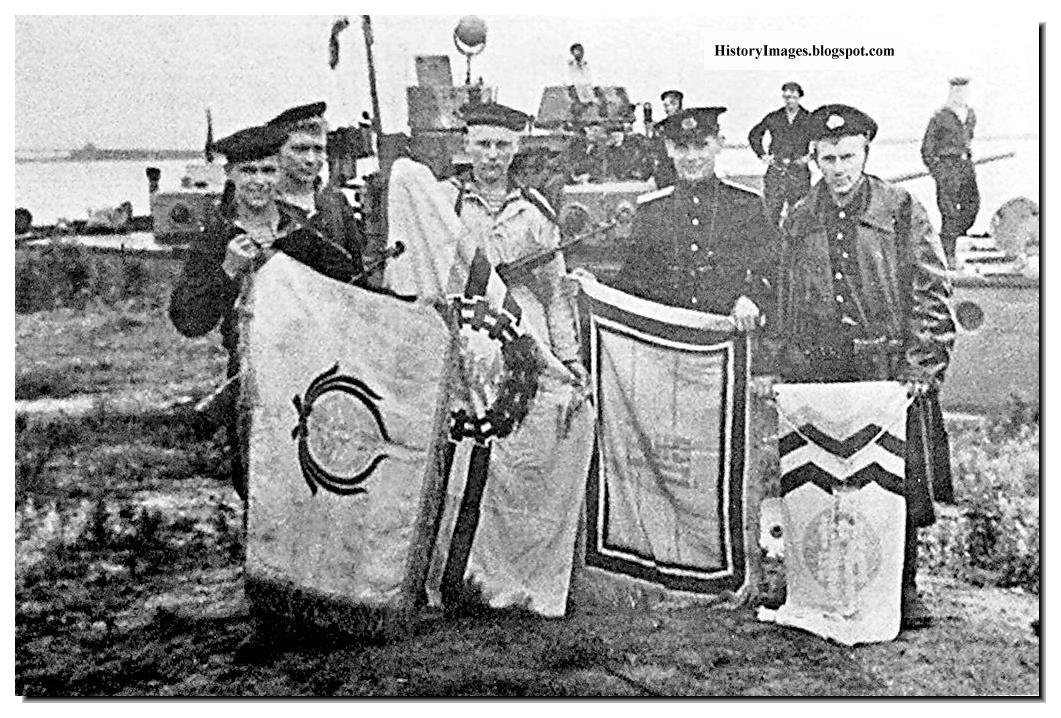
| Russian sailors with captured Japanese flags |
 |
| The Japanese Kwantung Army surrenders to the Russians. 1945. Changchun. |
 |
| Red Army soldiers patrol a street in a Chinese town |
 |
| Soviet soldiers sit on the throne of the Last Chinese Emperor, Puyi. September 1945 |
 |
| The Russians send the puppet Chinese emperor Puyi to the USSR. |
At the end of World War II, Puyi was captured by the Soviet Red Army on 16 August 1945 while he was in an airplane fleeing to Japan. The Soviets took him to the Siberian town of Chita. He lived in a sanatorium, but was later taken to Khabarovsk near the Chinese border.
 |
| Russian soldiers pose against a destroyed Japanese tank on Shumshu Islands (in the Kuril Islands) |
Popular Articles On This Site
-
The German women raped and forced into sexual slavery at the end of WW2 are still among the most forgotten, suppressed, ridiculed vi...
-
As the 1945 began, the Russian army inexorably began to close into Germany. The result was foregone. But for the Nazi regime and the Ger...
-
Guido Knopp, sums the Waffen-SS perfectly in his documentary “Waffen SS – Hitler’s Elite Fighting Force”: “Had that marvellous courage ...
-
As described by both Churchill and Elliott Roosevelt in their memoirs, "Stalin rose and proposed a blood-curdling toast. The streng...
-
In the years 1945 to 1946 Germany was a collection of denouncers, black-marketeers, prisoners, refugees from justice and tireless whingers....
-
Two Waffen SS soldiers have a drink. In the background burns a T-34 tank Boys will be boys! SS troops welcomed by Ukrainian g...
-
Wounded German soldiers near Minsk, Belarus. 1944. It was a painful process. The once mighty Wehrmacht was slowly disintegrating. It ...
-
Going about their daily work. Einsatzgruppe killing Poles. Einsatzgruppen. In German it means an innocuous, "task force". In...
-
Berlin. April 1945. Apocalypse. Hell on Earth. This savage battle on this ancient cultured city is perhaps one of the most brutal battl...
Points To Ponder
WHY WAS THE FIGHTING ON THE RUSSIAN FRONT SO FIERCE DURING WW2?
It is difficult to distinguish between the quality of both the German and Russian soldiers. Both were motivated by their love for their motherland. But there were others factors that drove the two sides to such desperate fighting.
One, both sides knew that this was a no-holds bar war. Not fighting was thus not an option.
Second, both Hitler and Stalin had squads that killed any deserter. Turning away from fighting was just not possible.
Thus was seen some of the most bitter, brutal and desperate fighting on the WW2 eastern (Russian) Front.
"Those who do not remember the past are condemned to repeat it."
-- George Santayana
Quotes....
"Be polite; write diplomatically; even in a declaration of war one observes the rules of politeness."
--Otto von Bismarck
"When the enemy advances, withdraw; when he stops, harass; when he tires, strike; when he retreats, pursue.'
--Mao Zedong
Quotes....
"The main thing is to make history, not to write it."
--Otto von Bismarck
"When you have to kill a man it costs nothing to be polite."
--Winston Churchill
Quotes....
"In time of war the loudest patriots are the greatest profiteers."
--August Bebel
"God is not on the side of the big battalions, but on the side of those who shoot best."
--Voltaire
Quotes about War....
"Anyone who has ever looked into the glazed eyes of a soldier dying on the battlefield will think hard before starting a war."
---Otto von Bismarck
Quotes....
"Naturally the common people don't want war; neither in Russia, nor in England, nor in America, nor in Germany. That is understood. But after all, it is the leaders of the country who determine policy, and it is always a simple matter to drag the people along, whether it is a democracy, or a fascist dictatorship, or a parliament, or a communist dictatorship. Voice or no voice, the people can always be brought to the bidding of the leaders. That is easy. All you have to do is to tell them they are being attacked, and denounce the pacifists for lack of patriotism and exposing the country to danger. It works the same in any country."
--Hermann Goering
Quotes....
"To conquer the enemy without resorting to war is the most desirable. The highest form of generalship is to conquer the enemy by strategy."
--Tzu Sun
"All men are brothers, like the seas throughout the world; So why do winds and waves clash so fiercely everywhere?"
--Emperor Hirohito