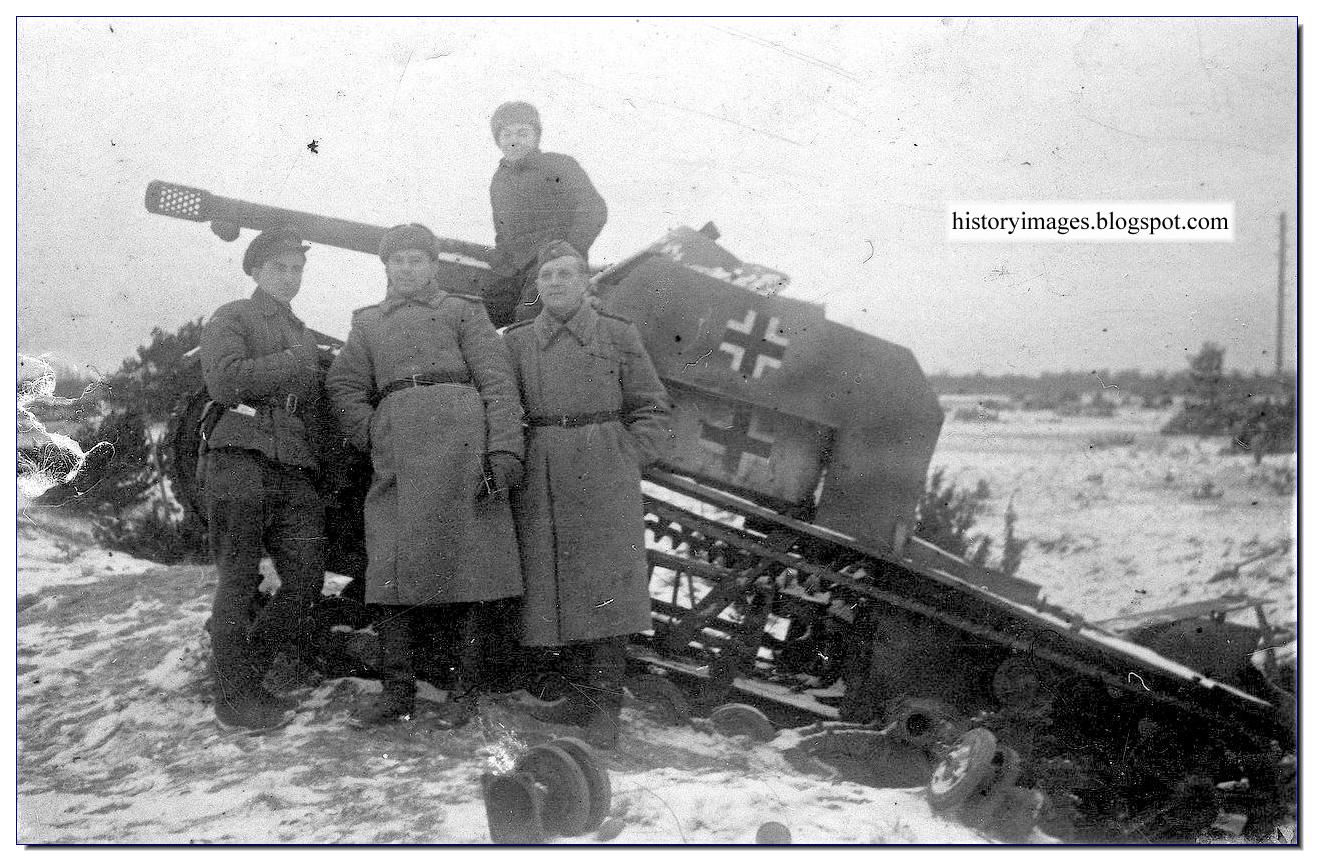
German soldiers take cover against a destroyed Soviet KV-1 tank in Lake Ladoga, Leningrad, September 15, 1943.
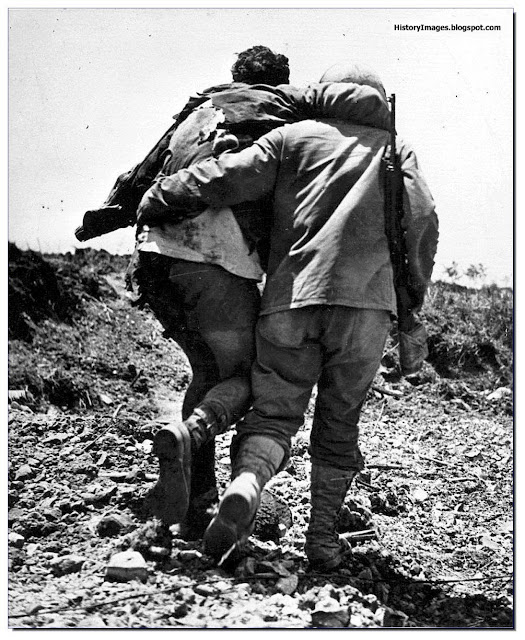
The Battle at Okinawa was bloody. It convinced the Americans that the Japanese would not surrender with a fight. Seen in the image is an wounded American soldier.
German soldier captured at Anzio, Italy in 1944 escorted by an American soldier.
Romanian soldiers with a ZB 20 machine gun at Stalingrad in 1942. The flanks of the Germans were covered by ill-armed Romanians and Italians which allowed the Red Army to cut off the Sixth Army in November 1942.
Polish POW carry loaves of bread escorted by a German soldier. The defeat in September 1939 was very bitter for the proud Polish.
A German soldier stands guard over a captured Polish 75 mm anti-aircraft gun atop a railroad car in 1939
A German U-Boat crew surrender to Polish sailors at the British port of Portland. The U-Boat captain is Lieutenant zur See Uwe Kock
German general Guderian and Red Army Commander Vladimir Yulianovich Borovitsky at Brest on September 21, 1939 to work out the German and Soviet boundary demarcation of occupied Poland
German soldier beside a Tiger tank and a destroyed Soviet KV-1 tank at Lake Ladoga, Leningrad, September 1943.
German soldiers of a machine gun unit change their position at Stalingrad. October 1942.
The German U-Boat building yard at Bremen after it was occupied by the Allies. May 5, 1945. In the background from left to right in the center - U-3060 and U-3062, in the foreground from left to right - U-3061 and U-3063.
Waffen SS Colonel Max Wunsche, commander of the 12th SS Regiment of the Hitlerjugend Division (bandaged head) with men of the 25th regiment of the SS at Po (village in France) on June 9, 1944. Partly seen on the right side of the image is Rudolf, son of German foreign minister von Ribbentrop.
Franco did not officially involve Spain on the Axis side, but Spanish volunteers did fight in the Wehrmacht. It was called the "Blue Division"(the 250th infantry division). Here a soldier is seen by the grave of a comrade.
Hungarian soldiers on bicycles on the eastern front.
Curious Parisians atop a destroyed German Panther tank. 1944
German soldiers examine a captured French armored car, Panhard 178. May-June 1940
Fritz Sauckel after he was hanged on October 16, 1946. Ernst Friedrich Christoph "Fritz" Sauckel was a German Nazi politician, Gauleiter of Thuringia and the General Plenipotentiary for Labour Deployment from 1942 until the end of the Second World War. Sauckel was among the 24 persons accused in the Nuremberg Trial of the Major War Criminals before the International Military Tribunal. He was found guilty of war crimes and crimes against humanity, and was sentenced to death by hanging. Last words: "I respect the American officers and soldiers, but not the American justice system"
Polish soldiers captured by the Germans after the fall of Poland. 1939. The bitterness of defeat shows on the faces of the proud men.
German soldiers walk the streets of the Dutch village of Wagenborgen as dead Dutch soldiers lie. May 1940.
German soldiers adjust their Flak 36 anti-aircraft gun at Novorossiysk, Russia. September, 1942.
Three Canadian soldiers captured by the Germans during the Dieppe Raid. The Raid was a disaster for the Allies
A German Stuka Dive Bomber flies over Valletta, the capital of British Malta in 1941.
Waffen SS soldiers in Hungary in 1945. It was a desperate losing battle for these tough, motivated fighters.
British POW in North Africa covered by Italian soldiers. December 1941. The prisoners were captured during the advance of Italian troops in Cyrenaica during the battle at Bir el Gubi.
A destroyed Berlin in May 1945. German civilians walk dazed as the occupying Russian soldiers look on.
Related
Some Random Rare Images Of The Second World War: Part 2
Some Random Rare Images Of The Second World War: Part 3
Wounded German soldiers near Minsk, Belarus. 1944.
It was a painful process. The once mighty Wehrmacht was slowly disintegrating. It started with Moscow in 1941 and then Stalingrad in 1942-43. It was a slow downfall of a mighty fighting machine that the world will ever see again. Wrought by the obstinate stupid decisions of Hitler that made little military sense. His main weakness was that he did not give a free hand to his brilliant military commanders like Manstein and Guderian. (Unlike Stalin)
The years 1943-45 were years that saw a gradual obliteration of the German Army by the Red Army. The very fact that it took three years for the Russians to do it speaks volumes of the fighting quality of the German soldier.
Here it is. In images.

Soviet officers interrogate a captured German general.
Batov's 65th Army now fought their way into Babruysk street by street against stiff resistance from the German rearguard. Babruysk, in ruins and with much of its population killed during the German occupation, was liberated on June 29, 1944, the 383rd Infantry Division commencing withdrawal towards dawn: no further elements of Ninth Army would escape from east of the Berezina. The German breakout had allowed around 12,000 troops - mostly demoralised and without weapons - from the pocket east of Babruysk to get out, but the Soviets claimed 20,000 taken prisoner. A further 50,000 were dead: Soviet accounts speak of the area being carpeted with bodies and littered with abandonedmateriel. The Soviet writer, Vasily Grossman, entered Babruysk shortly after the end of the battle:
"Men are walking over German corpses. Corpses, hundreds and thousands of them, pave the road, lie in ditches, under the pines, in the green barley. In some places, vehicles have to drive over the corpses, so densely they lie upon the ground [...] A cauldron of death was boiling here, where the revenge was carried out"
Ninth Army had been decisively defeated, and the southern route to Minsk was open.

Destroyed German equipment in the Zhlobin highway. Belarus
Destroyed German tanks in Belarus
Russian warplanes attack a German convoy in Belarus, the summer of 1944.
Russian self-propelled guns SU-76M pass dead German soldiers. Belarus, Spring 1944.
Soviet soldiers in the battle on the streets of the city of Polotsk. July 1-4, 1944
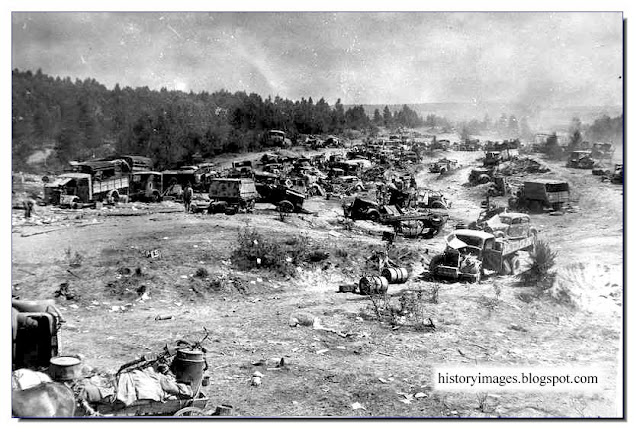
Broken and abandoned German equipment in Bobruisk.
Red Army soldiers are fighting in the streets of Belgrade. Picture was taken at the height of the battle for Belgrade. In the foreground, a machine gunner with the DP-27. October 19, 1944.
A Belgrade resident looks at a dead German soldier. Brothers Jugovic Street (city center). 19-20 October 1944. In the battle of Belgrade itself the defending Germans, Italians, Chetniks lost 18,000 (killed) men. The loss of the Red Army - about 900 men, People's Liberation Army of Yugoslavia lost (though they actually were in the second tier) - about 2,200 men.
A Dead German soldier on the road in a suburb of Belgrade Topchidere. October 16, 1944.
Soviet tanks shot this German armored convoy to pieces in Belgrade. In the foreground - the Italian ACS Semovente L6/40 da 47/32, in the background of the tank, which served as her base: L6/40. October 1944.
Soviet soldiers with captured German Panzer 4 tanks in Belgrade. 1944.
A destroyed German self-propelled gun StuG III on the Boulevard of Liberation in Belgrade. Picture taken on October 18, 1944 - at the height of the battle for the city. However, the street is full of curious civilians, including children. In the distance one can see the dome of the Cathedral of St. Mark.
German soldiers under cover of a Tiger tank from the 502th battalion of heavy tanks at Narva, Estonia. February 1944.
Estonians in the Red Army pose against a German ACS
A column of German prisoners of war held near the railway station in Riga. In 1944. Some of them are smiling. Glad that the agony is over?
German soldiers pass by an immobilised Soviet IS-2 tank, during the fighting in Jelgava (Mitau) central Latvia. In 1944.
German soldiers surrender in Vilnius. July 11, 1944.
German snipers clean weapons and equipment in between battles. Romania, summer 1944. These guys are doing their job despite the fact that they knew the end was near.
Destroyed German military hardware lies strewn in Znojmo in Czechoslovakia. 1945
German tank destroyer Jagdpanzer 38, Hetzer lies abandoned in Prague. May 1945.
The Germans were retreating from Czechoslovakia. Here they are seen leaving for Hrushky, a small Czech town. April 1945.
A German Stug 3 stands forlorn on the streets of Prague. 1945. The German soldiers were gone. They were dead or had retreated.
German military equipment lie broken in Znojmo, Czechoslovakia. May 1945. The Russians had given a hammering.
Soviet troops with Hungarian POW on Debozy Street, Budapest. January 1945
A dead German Waffen SS soldier on the street in Budapest. February 1945
A column of wrecked German armored cars and personnel carriers in Budapest
DFS-230 glider sergeant Filiusa George (Georg Filius), crashed into a building number 35 or 37 (according to different sources), Attila the street while trying to land on the Bloody Meadow in Budapest on February 4, 1945. Gliders were used to give ammunition to the soldiers fighting there. The pilot died in the crash.
These Germans in a Sonderkraftfahrzeug 251are still fighting on. Fighting Soviet troops in Hungary. January 1945
German soldiers surrender in Budapest, Hungary. February, 1945
Russian troops in Budapest
German POW are made to see the remains of the inmates of the Majdanek camp. Outskirts of the city of Lublin, Poland, 1944.
July 30, 1944. Poland. German troops firing at the advancing Red Army with a Pak 40 anti-tank gun.
German troops aboard a Sturmpanzer 43 play with a monkey in Warsaw, Poland. August-September 1944
Grenadiers of the German SS Panzer Division "Totenkopf" change position during the battle of Warsaw, running past a burning Soviet T-34 tank. August 18, 1944.
A dead German soldier lies in Vienna. April 1945
Austrian children play near the remains of a heavy Panzer 4 tank outside Vienna
This family of a Nazi official killed itself rather than fall into Russian hands. Vienna, Austria. 1945. Soviet officers stand watching the bodies.
Soviet soldiers march down a street of Vienna.
Popular Articles On This Site
-
The German women raped and forced into sexual slavery at the end of WW2 are still among the most forgotten, suppressed, ridiculed vi...
-
As the 1945 began, the Russian army inexorably began to close into Germany. The result was foregone. But for the Nazi regime and the Ger...
-
Guido Knopp, sums the Waffen-SS perfectly in his documentary “Waffen SS – Hitler’s Elite Fighting Force”: “Had that marvellous courage ...
-
As described by both Churchill and Elliott Roosevelt in their memoirs, "Stalin rose and proposed a blood-curdling toast. The streng...
-
In the years 1945 to 1946 Germany was a collection of denouncers, black-marketeers, prisoners, refugees from justice and tireless whingers....
-
Two Waffen SS soldiers have a drink. In the background burns a T-34 tank Boys will be boys! SS troops welcomed by Ukrainian g...
-
Wounded German soldiers near Minsk, Belarus. 1944. It was a painful process. The once mighty Wehrmacht was slowly disintegrating. It ...
-
Going about their daily work. Einsatzgruppe killing Poles. Einsatzgruppen. In German it means an innocuous, "task force". In...
-
Berlin. April 1945. Apocalypse. Hell on Earth. This savage battle on this ancient cultured city is perhaps one of the most brutal battl...
Points To Ponder
WHY WAS THE FIGHTING ON THE RUSSIAN FRONT SO FIERCE DURING WW2?
It is difficult to distinguish between the quality of both the German and Russian soldiers. Both were motivated by their love for their motherland. But there were others factors that drove the two sides to such desperate fighting.
One, both sides knew that this was a no-holds bar war. Not fighting was thus not an option.
Second, both Hitler and Stalin had squads that killed any deserter. Turning away from fighting was just not possible.
Thus was seen some of the most bitter, brutal and desperate fighting on the WW2 eastern (Russian) Front.
"Those who do not remember the past are condemned to repeat it."
-- George Santayana
Quotes....
"Be polite; write diplomatically; even in a declaration of war one observes the rules of politeness."
--Otto von Bismarck
"When the enemy advances, withdraw; when he stops, harass; when he tires, strike; when he retreats, pursue.'
--Mao Zedong
Quotes....
"The main thing is to make history, not to write it."
--Otto von Bismarck
"When you have to kill a man it costs nothing to be polite."
--Winston Churchill
Quotes....
"In time of war the loudest patriots are the greatest profiteers."
--August Bebel
"God is not on the side of the big battalions, but on the side of those who shoot best."
--Voltaire
Quotes about War....
"Anyone who has ever looked into the glazed eyes of a soldier dying on the battlefield will think hard before starting a war."
---Otto von Bismarck
Quotes....
"Naturally the common people don't want war; neither in Russia, nor in England, nor in America, nor in Germany. That is understood. But after all, it is the leaders of the country who determine policy, and it is always a simple matter to drag the people along, whether it is a democracy, or a fascist dictatorship, or a parliament, or a communist dictatorship. Voice or no voice, the people can always be brought to the bidding of the leaders. That is easy. All you have to do is to tell them they are being attacked, and denounce the pacifists for lack of patriotism and exposing the country to danger. It works the same in any country."
--Hermann Goering
Quotes....
"To conquer the enemy without resorting to war is the most desirable. The highest form of generalship is to conquer the enemy by strategy."
--Tzu Sun
"All men are brothers, like the seas throughout the world; So why do winds and waves clash so fiercely everywhere?"
--Emperor Hirohito


 German soldier captured at Anzio, Italy in 1944 escorted by an American soldier.
 Romanian soldiers with a ZB 20 machine gun at Stalingrad in 1942. The flanks of the Germans were covered by ill-armed Romanians and Italians which allowed the Red Army to cut off the Sixth Army in November 1942.
 Polish POW carry loaves of bread escorted by a German soldier. The defeat in September 1939 was very bitter for the proud Polish.
 A German soldier stands guard over a captured Polish 75 mm anti-aircraft gun atop a railroad car in 1939
 A German U-Boat crew surrender to Polish sailors at the British port of Portland. The U-Boat captain is Lieutenant zur See Uwe Kock
 German general Guderian and Red Army Commander Vladimir Yulianovich Borovitsky at Brest on September 21, 1939 to work out the German and Soviet boundary demarcation of occupied Poland
 German soldier beside a Tiger tank and a destroyed Soviet KV-1 tank at Lake Ladoga, Leningrad, September 1943.
 German soldiers of a machine gun unit change their position at Stalingrad. October 1942.
 The German U-Boat building yard at Bremen after it was occupied by the Allies. May 5, 1945. In the background from left to right in the center - U-3060 and U-3062, in the foreground from left to right - U-3061 and U-3063.
 Waffen SS Colonel Max Wunsche, commander of the 12th SS Regiment of the Hitlerjugend Division (bandaged head) with men of the 25th regiment of the SS at Po (village in France) on June 9, 1944. Partly seen on the right side of the image is Rudolf, son of German foreign minister von Ribbentrop.
 Franco did not officially involve Spain on the Axis side, but Spanish volunteers did fight in the Wehrmacht. It was called the "Blue Division"(the 250th infantry division). Here a soldier is seen by the grave of a comrade.
 Hungarian soldiers on bicycles on the eastern front.
 Curious Parisians atop a destroyed German Panther tank. 1944
 German soldiers examine a captured French armored car, Panhard 178. May-June 1940
 Fritz Sauckel after he was hanged on October 16, 1946. Ernst Friedrich Christoph "Fritz" Sauckel was a German Nazi politician, Gauleiter of Thuringia and the General Plenipotentiary for Labour Deployment from 1942 until the end of the Second World War. Sauckel was among the 24 persons accused in the Nuremberg Trial of the Major War Criminals before the International Military Tribunal. He was found guilty of war crimes and crimes against humanity, and was sentenced to death by hanging. Last words: "I respect the American officers and soldiers, but not the American justice system"
 Three Canadian soldiers captured by the Germans during the Dieppe Raid. The Raid was a disaster for the Allies
 A German Stuka Dive Bomber flies over Valletta, the capital of British Malta in 1941.
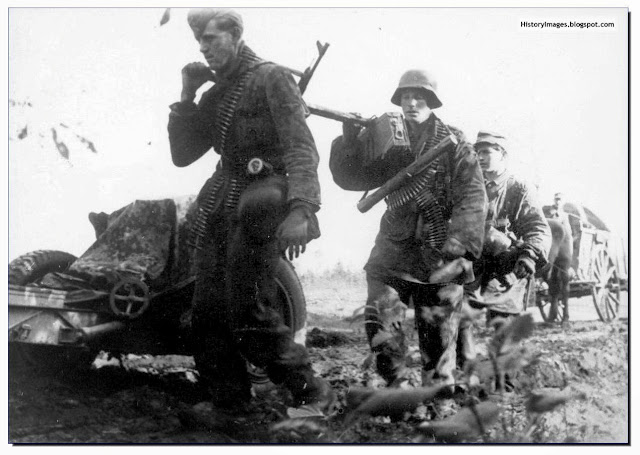 Waffen SS soldiers in Hungary in 1945. It was a desperate losing battle for these tough, motivated fighters.
 British POW in North Africa covered by Italian soldiers. December 1941. The prisoners were captured during the advance of Italian troops in Cyrenaica during the battle at Bir el Gubi.
 A destroyed Berlin in May 1945. German civilians walk dazed as the occupying Russian soldiers look on.


 German soldiers walk the streets of the Dutch village of Wagenborgen as dead Dutch soldiers lie. May 1940.
 German soldiers adjust their Flak 36 anti-aircraft gun at Novorossiysk, Russia. September, 1942.