Showing posts with label battle stalingrad. Show all posts

Rare pictures of Battle of Stalingrad

"The defenders of the city used to say that the streets, avenues and
parks near the Volga became slippery from blood, and that the Germans
slipped down to their doom."
General Chuikov

Abandoned German self-propelled guns, seized by Soviet troops at Stalingrad. This ACS Marder II had a 76.2-mm gun.


SOME FACTS OF STALINGRAD
1. On each square kilometer of Stalingrad Tractor Factory's territory weredropped approx. 2000 bombs (not counting small-gauge artillery and mortars).
2. On each running kilometer of the rail track were about 16 bomb craters.
3. On each running kilometer of pipelines were 15 direct hits.


A little story from Russia

My name is Anna Streltasova. In 1942,during the war, I lived in Stalingrad. My mother, my little sister, my father and I lived in an apartment house. My father worked on the machines at the nearby tractor factory. I was just finished with my secondary schooling and I had begun my education at the medical university. Along with my medical education, I was also a member of a voluntary civilian medical unit.

Late in the morning of August 23rd, I had come home from medical school and my mother had asked me to go to the market to purchase a watermelon and bring it home for lunch. As I was returning from the market, I heard air-raid sirens. Because I was only seventeen years old and afraid of nothing, this did not alarm me and I just ignored them. I had heard many sirens before and nothing had ever happened. My only purpose was to bring the watermelon home for my mother and little sister to enjoy. Mother was waiting to cut the watermelon on her cutting board, and she did so with a big sharp knife. Oh, it looked so red and ripe and delicious.

Just as we were about to eat, a bomb crashed into our building. Broken glass flew everywhere. My little sister was hit by glass fragments and was bleeding. Mother grabbed a pink cloth and attempted to stop the bleeding. The cloth was covered with red blood and red chunks of watermelon. Mother immediately snatched up my little sister to take her to the hospital. The bombs were falling all over the neighbourhood and the houses were on fire. I wanted to accompany them, but had to stay to help with the wounded that were pouring out into the street. I struggled to help get the wounded down to the ferry to escape.

There was a crowd of people out in the street, both military and civilian, many wounded. And many children. It was impossible for me to return to my home. There was no turning back for me. I voluntarily joined the army to work in a field hospital where my training and education would help.

Five years later, in 1947, I returned home to Stalingrad. There was nothing left of my neighborhood. My street was gone, my home was gone and my mother and little sister had disappeared forever. My last hope was that I would be able to find my father. But, in fact, on August 24, 1942, the German soldiers were already approaching the tractor factory. My father took up a rifle and others grabbed machine guns and some took T-34 tanks directly from their work on the tank assembly line, they ran out of the plant to stop the German troops. There was no Russian army unit nearby, so these brave citizen soldiers held the Germans off for three to four days until the first Russian troops were able to relieve them. Unfortunately I must tell you, my father was killed during this battle. In two short days of my young life, I lost my home, family and everything I had. From that day onward, watermelon's rich red colour fills me with such sorrow. I have never been able to eat or buy a watermelon. Never.

Anna Streltasova
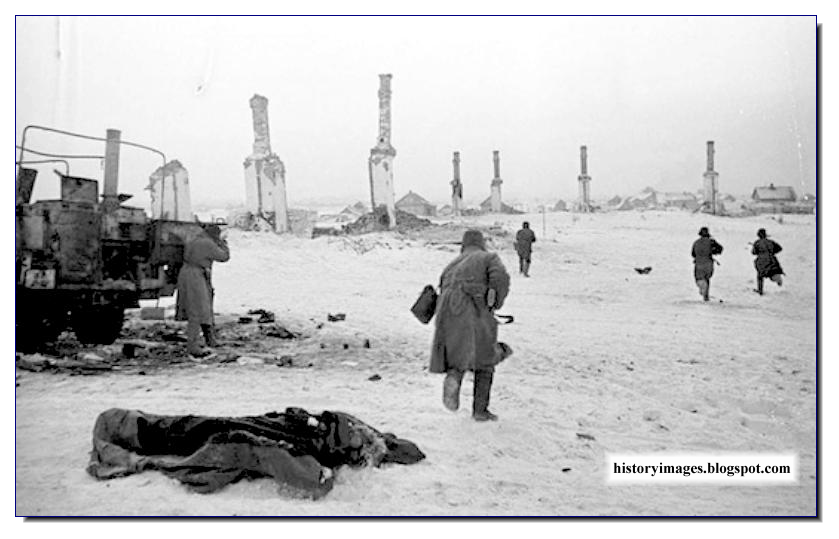
Russian troops in action at Stalingrad as the Russian winter rages on.


THE IFS AND BUTS OF STALINGRAD.....

Few would disagree that the loss of the German 6th Army at Stalingrad represented the turning point of the Eastern front, indeed of WWII in Europe. Heroic as the efforts of the Luftwaffe's air and ground crews were, the defenders could never have been adequately supplied by airlift alone.

Could the relief attempt mounted by General Hoth's 4th Panzer Army ever have reached the cauldron across150km of wintry steppe?

Once the panzers had punched a corridor through, 800 lorries loaded with 3,000 tons of supplies were to restore 6th Army's fighting strength and evacuate the wounded; von Manstein intended that Paulus then initiate the breakout, spearheaded by his own remaining armour (some hundred-odd tanks).

By Christmas Eve, the relief attempt had stalled on the defences recently manned by the 2nd Guards Army on the banks of the *Myshkova river, less than fifty kilometres from the siege lines but still impossibly far for the defenders to have reached even had Paulus willed the abandonment of the city.

By then the tank strength of the LVII Panzerkorps had been worn down by twelve days of bitter fighting and the men of its constituent 6, 17 and 23 Panzer-Divisions physically exhausted by constant combat in snow and cold, without any shelter on the open steppe.

Finally, the gallant and self-sacrificial relief attempt was doomed - even as the fighting for Vyerkhnye-Kumskiy approached its climax - by the Russian 'Little Saturn' onslaught (16th December) against Armee-Abteilung Hollidt and the Italian 8th Army; as the latter collapsed and Russian tank brigades threatened to overrun the airfields supplying Stalingrad, the strongest formation, 6 Panzer-Division, was urgently required on the far side of the Don. On Christmas Eve, with tears in their eyes, the troops saluted their comrades in the cauldron- now doomed to death in combat or the slower agony of the camps, the fate most feared of all.


These German soldiers froze to death in Stalingrad.


In contrast to the Germans who were freezing to death, the Russians were unrelenting.

General Chuikov

In August 1942 the Germans launched a direct attack against Stalingrad, committing up to 22 divisions with more than 700 planes, 500 tanks, 1,000 mortars, and 1,200 guns. Chuikov, in response, allegedly declared, "We shall hold the city or die here." Much of the fighting in the city and on its perimeters was at close quarters, with bayonets and hand grenades. About 300,000 Germans were killed or captured in the course of the campaign; Soviet casualties totaled more than 400,000. In November the Soviet forces began to counterattack and by the end of the year were on the offensive.
General Chuikov subsequently led his forces into the Donets Basin and then into the Crimea and north to Belorussia before spearheading the Soviet drive to Berlin. Chuikov personally accepted the German surrender of Berlin on May 1, 1945.
After the war he served with the Soviet occupation forces in Germany
(1945-53), commanding those forces from 1949. He headed the Kiev military district from 1953 to 1960 and thereafter held a variety of military assignments in Moscow. He was a candidate member of the Communist Party's Central Committee from 1952 to 1961 and a full member from 1961 until he
died.

Hans Wijers
History Research WWII

The German lost. A Russian soldiers waves the red flag.

"Stalingrad" The Movie


Share this PostPin ThisShare on TumblrShare on Google PlusEmail This

Battle for Stalingrad: Some RARE pictures

"The troops of the Don Front at 4 pm on the 2nd February 1943 completed the rout and destruction of the encircled group of enemy forces in Stalingrad. Twenty two division have been destroyed or taken prisoner."

- Lieutenant General Rokossovski - February 1943


A Russian gun booms on the streets of Stalingrad.

-----------
The disaster of Stalingrad profoundly shocked the German people and armed forces alike...Never before in Germany's history had so large a body of troops come to so dreadful an end. 
- General Siegfried von Westphal - 1943
-------------

Early on the morning of 23 August 1942, the 16th Panzer Division raced eastwards over the steppe from the river Don. That same evening, it halted on the bank of the Volga. The tank crews gazed across towards Asia. They had reached the designated boundary of the Third Reich's eastern territories. Messerschmitt fighters performed victory rolls above their heads. Many soldiers thought that the war was won. To their right, the city of Stalingrad blazed from the first of General von Richthofen's air raids, which killed 40,000 civilians. The only resistance the panzer crews faced came from anti-aircraft guns operated by young women barely out of high school. 'We had to fight shot for shot', the division reported, 'against thirty-seven flak positions manned by tenacious fighting women until they were all destroyed.' Thus began the most pitiless, and perhaps the most important, battle in history.

FROM anthonybeevor.com
No this is not Hiroshima or Nagasaki. This is Stalingrad.


Hitler had told General Friedrich Paulus that with his Sixth Army, the most powerful in the Wehrmacht, he could 'storm the heavens'. But then, in a bold encirclement by Soviet armoured forces, over a quarter of a million Germans were trapped far from home, and increasingly far from help. Stalingrad marked not just the psychological turning-point of the war, it was the first major modern battle fought in a city, with thousands of helpless civilians caught up in its horrors. In this titanic struggle between Stalin and Hitler, men were driven beyond the limits of physical and mental endurance. National loyalties were also dislocated. Paulus's Sixth Army depended on 50,000 Soviet citizens in German uniform, while the NKVD used German Communist writers in its tactics to wear down the besieged.
The Germans spring into action.
RUMORS

In November 1942, after failing to defeat the besieged city of Stalingrad and as the Russian winter approached, tens of thousands of German soldiers found themselves isolated, surrounded by Soviet troops, without food or any prospect of reinforcements. Against this background, various rumors developed. In the German camp, soldiers spread the story that, one night, covertly and disguised as a corporal, Hitler himself visited his despairing troops and promised them that he would quickly send them food and reinforcements and that victory was close at hand.

During this very same period, on the other side of the battlefield, rumors spread that Stalin had visited the city named after him, covertly, of course, to encourage his troops and raise their morale. He too promised them a sweeping victory.
Source
The destruction of Stalingrad as seen from the skies.

BATTLE FOR STALINGRAD


This photo perhaps symbolises the fortunes of Nazi Germany henceforth.

PERSONAL STORIES FROM STALINGRAD


By the shore were people, including many children. Using small spades, as well
as their hands, they dug holes to hide from bullets and artillery shells. Atdawn
German planes appeared over the Volga. On a hedge-hopping flight they flew
over a ferry and bombed and opened fire from machine guns. From above, it was very well visible to the pilots, that on the shore civilians were waiting. Many
times we saw enemy pilots acting as professional assassins. They opened fire on
the unarmed women and children and selected targets so as to maximize the
number of people killed. The pilots dropped bombs in a crowd at the moment
they were beginning to board a boat, fired at the decks of the boats, and
bombed islands on which hundreds of wounded had accumulated. The people
crossed the river not only on boats and barges. They sailed on overcrowded
boats, even on logs, barrels, and boards bound with wire. And on each floating
point the fascists opened fire from the air. It was hunting of the people.


K.S. Bogdanova.


Russian soldiers have a bite to eat.

THE DEATH THROES OF THE GERMAN SIXTH ARMY IN STALINGRAD

Soviet Armies 62, 65, 66 were mobilised with full artillery support on the
last day of January and into the first day of February. The Soviet
artillery had moved their guns into firing positions in close proximity to
the German lines. All available Soviet bombers had been made ready,
confident of success because an effective air blockade and anti-aircraft
effort was in place. German fighter aircraft would be unable to get through
this blockade. The soviet guns were shooting in a tiered position, one being
higher than the other. First the lower gun would fire and then the higher.
Eight artillery regiments supported the 214th infantry division and this was
in excess of what had originally been planned. At daybreak the tremendous
artillery bombardment began. After three to five minutes, German soldiers
were seen creeping out of their trenches, fleeing their tanks and abandoning
cellars. Soldiers dropped to their knees -- lifting their arms in surrender.
Others dashed back into their trenches and shelters and disappeared into the
smoke and fire. The areas around the factory had turned into flame and
destruction. The artillery barrage continued all day while the Russian
bombers flew sortie after sortie unopposed. Of the German troops, both north
and south, that continued to fight on against overwhelming odds, by nine o'
clock on the morning of the thirty-first of January, the southern group was
no longer an effective force.

Early in the morning on February 1st, the German Generals, Rosske and
Schmidt reluctantly accepted the surrender terms offered to them and gave
the order to immediately stop fighting to the southern section of the German
army. The soldiers were to surrender as a group.
Despite the order to surrender, one German company held out and this was
600-700 meters south of the school building. Major I. M. Ryjob of the
64th Soviet Intelligence Agency went with three Germans to persuade this
hold-out company to surrender. As the major's automobile approached the
school, with the German translators, he was able to transmit the order of
General Rosske to cease fighting immediately due to the fact that formal
talks about general capitulation were about to begin.

On February 2nd, more than 40,000 soldiers and officers of the northern
group of German troops surrendered to the overwhelming pressure. Field
Marshal Paulus was said to have given an order that the northern army stops
fighting. At a later date he stated that he had never given such an order.
General Strekker, who was the commander of the northern army, also stated
that he had never ordered them to stop fighting. During the period of
January 10 to February 2, 1943, Soviet troops under the command of General
K. K. Rokossovsky smashed through 22 enemy divisions with more than 160
different attached units of the German 6th Army. 91,000 Germans, including
2,500 officers and 24 generals were captured. In these battles, the enemy
had lost nearly 140,000 soldiers and officers. The Soviet Air Force and
anti-aircraft guns had damaged or destroyed more than 800 German aircraft.

STALINGRAD NOV 1942 German Wartime Newsreel


A STORY FROM STALINGRAD

Divisional commander Sokolov reported an interesting incident to me on 23 January. While entering the western reaches of the Red October settlement, his troops encountered and surrounded a heavily reinforced German position. The prevent the loss of any more lives, the German garrison was offered capitulation terms. After lengthy negotiations, the Germans asked our troops for some bread. Our troops pitied the enemy and sent over several loaves. After recieving the bread and consuming it, the Germans resumed firing.After seeing such "diplomatic relations" our troops contacted the artillerymen. They brought forward several guns and completely annihilated the German stronghold at point blank range.

..........

 V.I. Chuikov's book - "The battle of Stalingrad" .
BEST WAR FILMS: "STALINGRAD"
Share this PostPin ThisShare on TumblrShare on Google PlusEmail This

BATTLE FOR STALINGRAD: The most brutal fighting; it turned the tide against Nazi Germany (LARGE IMAGES)


Some of the most brutal fighting ever in history  in any war took place at Stalingrad.....The images of Stalingrad are fascinating.


Stalingrad was not fought on the Queensberry rules. It was brutal and dehumanising. Here German soldiers have taken a position in a house. The fighting in Stalingrad was house-to-house. Street-by-street. Hell on earth.


A German soldier at Stalingrad in September, 1942.


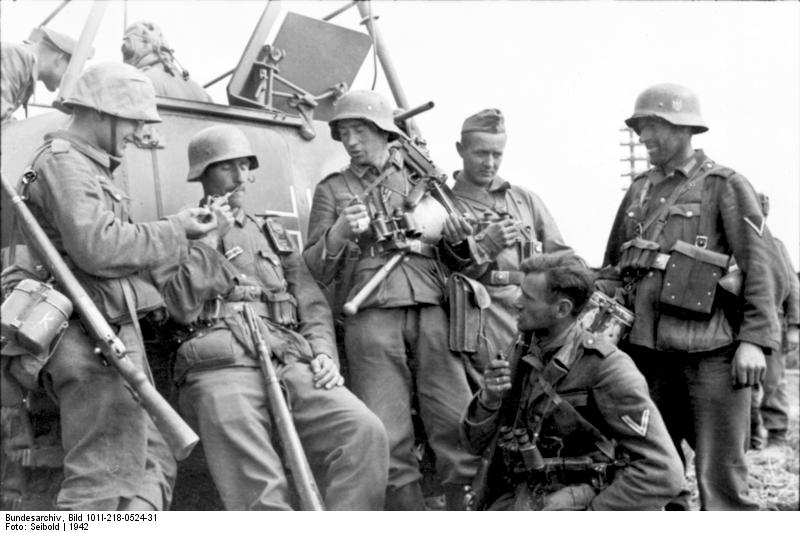
German soldiers enjoy a smoke near a APC. 1942. Stalingrad


Russians in action

1943. Stalingrad. After the Sixth Army had fallen. Italian POW. Starving, broken, hopeless. And very weary.

(Image: S Alperin) Russian soldiers rest during a rare break in the fighting. The rifle seen is a automatic AVS 36 Soviet rifle. The soldier standing has a anti-tank RPG-40 anti-tank grenade slung around his shoulder.

(Image: Elsner) A wounded German soldier has a smoke with Luftwaffe pilots before being flown to a hospital. A German controlled airfield. Stalingrad. Winter. 1942.

(Image: Kurt Heinke. Copyright-Bundesarchiv) A German lieutenant sits amongst the ruins of s factory in Stalingrad. 1942.

December 1942. Stalingrad. The tough Russian officers who made it possible. (Left to right) Chief of Staff of the 62nd Army Col. NI Krylov, Commander of the 62nd Army, Lieutenant General VI Chuikov, member of the military council of the army, KA Gurov, Col. AI Rodimtsev.


Russian soldiers with an anti-aircraft gun wait for the Luftwaffe bombers


 A funeral at Stalingrad. August 1942


A priest conducts a funeral service. Stalingrad. August, 1942.


Late summer. 1942. Stalingrad. Things were good then. Germans enjoy  music


Summer 1942. Stalingrad area. A German officer offers his men cigarettes.

Initially the German soldiers were optimistic and full of motivation. But it gradually petered out.


SURRENDER AT STALINGRAD AS REPORTED BY BBC - FEB 2, 1943

The Soviet Government has announced the final defeat of the German 6th Army at the port of Stalingrad, in southern Russia.

A statement late this evening said: "Our forces have now completed the liquidation of the German Fascist troops encircled in the area of Stalingrad.

"The last centre of enemy resistance in the Stalingrad area has thus been crushed."

The declaration brings to an end five months of heavy fighting for the city. The battle has been described as among the most terrible of the war so far.

Another 45,000 German soldiers have been taken prisoner in the last two days, bringing the total in custody to over 90,000 officers and men.

The prisoners are understood to be in an appalling condition after enduring months of starvation in temperatures down to -30°C.

They are the remains of the 330,000-strong German force sent to take Stalingrad.

The rest - about a quarter of a million men - have died, as many from illness, starvation and frostbite as from the fighting itself.

The 6th Army has been trapped inside the city, completely surrounded by the Red Army, for almost three months during the harshest part of the Russian winter.

They have had to rely totally on air drops by the Luftwaffe for food.

Atrocious weather conditions have reduced the amount getting through to just 90 tonnes a day - less than a third of what they needed.

The German commander of the 6th Army, Field-Marshal Friedrich Paulus, gave himself up two days ago.

He had been in a hopeless position since early December, when a last-ditch rescue attempt was driven back by Soviet troops.

He was given one earlier chance to surrender, on 8 January, by Soviet Regional Commander, Marshal Rokossovsky.

But Hitler repeated his order to the 6th Army that surrender would not be contemplated, and two days later the final Soviet offensive began to flush the Germans out of Stalingrad.

Paulus lost his last German-controlled airfield ten days later, on 22 January, and with it the last hope of any more regular supplies.

By 29 January the desperately weak 6th Army was split into two pockets of men.

The surrender of Field-Marshal Paulus brought the ordeal to an end for one of the groups.

The defeat of the second remnant today closes at last one of the most horrific chapters of the war so far.


Russians use their guns in a former factory


Soviet (or Russian) soldiers carefully make their way through the rubble


The Germans fight in the ruins


It is difficult to distinguish between the quality of both the German and Russian soldiers. Both were motivated by their love for their motherland. But there were others factors that drove the two sides to such desperate fighting.

One, both sides knew that this was a no-holds bar war. Not fighting was thus not an option.
Second, both Hitler and Stalin made squads that killed any deserter. Turning away from fighting was just not possible.


This is what remained of this city after the Battle for Stalingrad


The Germans realised that they had bitten off more than they could chew


This was the welcome the advancing German army was to get as they advanced into Russia


A German soldier is enthusiastic as they approach Stalingrad


 Stalingrad proved to be a graveyard of not only German soldiers but also its arms


Dead German soldiers at Stalingrad. Starvation and the cold.

BEST WAR FILMS: "STALINGRAD"

Share this PostPin ThisShare on TumblrShare on Google PlusEmail This

Battle for Stalingrad: The turning point in Second World War


A German unit at Stalingrad

BACKGROUND

The Battle of Stalingrad is considered by many historians to have been the turning point in World War Two in Europe. The battle at Stalingrad bled the German army dry in Russia and after this defeat, the Germany Army was in full retreat.


The Battle for Stalingrad was fought during the winter of 1942 to 1943. In September 1942, the German commander of the Sixth Army, General Paulus, assisted by the Fourth Panzer Army, advanced on the city of Stalingrad. His primary task was to secure the oil fields in the Caucasus and to do this, Paulus was ordered by Hitler to take Stalingrad.

Stalingrad was also an important target as it was Russia’s centre of communications in the south as well as being a centre for manufacturing.

The battle for the city descended into one of the most brutal in World War Two. Individual streets were fought over using hand-to-hand combat. The Germans took a great deal of the city but they failed to fully assert their authority. Areas captured by the Germans during the day, were re-taken by the Russians at night.

On November 19th, the Russians were in a position whereby they could launch a counter-offensive.

The failure of the German Army was nothing short of a disaster. A complete army group was lost at Stalingrad and 91,000 Germans were taken prisoner. With such a massive loss of manpower and equipment, the Germans simply did not have enough manpower to cope with the Russian advance to Germany when it came.

LETTERS FROM GERMAN SOLDIERS AT STALINGRAD......

From Corporal’s letter to his wife: “…Every day we ask ourselves the question: Where are our saviors and when will the hour of deliverance come? Will Russians kill us till this moment or not…”

One more letter: “…We are going through the great crisis and nobody knows how it will end. The situation is so critical that, in my humble opinion, it looks like what was happening near Moscow a year ago. “

October 28. Here is a real hell. Diving bombers and artillery.

October 29. Hot day for me… Terrible activity of Russian aviation.

November 2. At night colossal aviation. The thought of my soon death can’t go out of my mind. Our attacks are unsuccessful. The company commander Sergeant Lar is killed.

November 3. Noncommissioned officer Friedrick was killed.

November 8. The air raids again and again. No one knows whether he is alive in an hour…”


The Russians used dogs as weapons too. Explosives were strapped on the backs of the dogs. They were trained to crawl under tanks and under other vehicles for their food. When the dog did so under a panzer, the bomb went off. So the Germans shot any dog they saw coming towards their tanks.

LETTERS......

“January 15. How long will we still eke out that miserable existence and will it ever be better? We are always waylaid by the enemy. One wishes the other to die. Since we are surrounded and we do not have enough ammunition, we are forced to sit still. There is no exit from the boiler and will never be. “

“January 10. At exactly 6 am a terrible hurricane of fire begins in the west. I’ve never heard such a roar. During the whole day the countless number of planes fly over us and drop bombs. January 13… Such strange foreboding. Will we ever leave this place or not?”

 Starving men of a once proud Sixth Army shuffle along in Stalingrad after the surrender


"The anger of Russian soldiers and officers was vented on their German prisoners,skeletal and lice-infested. Some were shot on the spot. Others died when they were marched off in small columns, and Soviet soldiers sprayed them with machine-gun fire. In one case, the wounded commander of a company forced a captured German officer to kneel before him in the snow, cried out the reasons why he was seeking revenge, then shot him"
----------------------------
GERMAN LETTERS FROM SATLINGRAD

“December 8. The situation with food provision becomes more and more lamentable. One loaf of bread for seven people. We are forced to eat horses.

December 9. All feeble horses are slaughtered and eaten.

December 10. To starve is damn hard.

December 11. No hope for improvement. Now we know the price of bread.

December 12. Today I found an old piece of moldy bread. It was a real delicacy. We eat only once a day when food is distributed, and then starve for 24 hours…”
“… I would be extremely happy to get a piece of stale bread. But we don’t have even that.”
“… Three enemies make our lives very difficult: Russians, hunger and cold. Russian snipers keep us under constant control…”
“…Yesterday, we received vodka. At that time we were just cutting the dog so vodka was very handy. I have already killed four dogs but my friends can’t still eat their fill. I once shot a magpie and cooked it…”
People of Stalingrad with Red Army soldiers. Seems like a propaganda image. The Russians treated the civilians as ruthlessly as the Germans did.

Page 161

The Red Army again proved itself pitiless towards its own civilians.During the fighting for the Barrikady workers' settlements, a sergeant in the 389th Infantry Division (a former police sergeant from 161 'The Fateful City' Darmstadt) observed that 'Russian women who came out of the houses with their bundles and then tried to seek shelter from the firing on the German side, were cut down from behind by Russian machine-gunfire'.

LETTERS FROM STALINGRAD

“…Josef Gross had a dog. Well, it’s done – I’m not kidding…”

“…December 26. Today we cooked a cat.”

“…Elsa (the wife’s name), I do not want to make you sad thus won’t tell much… I just want to tell you that I will soon die from hunger…”

“…Many of those who didn’t even think about death last year today are dead. Many people lost their lives this year. In 1943, it will be even worse. If the situation doesn’t change and surroundings are not broken then we all will perish from hunger… There is no perspective.”
Russian tanks in Stalingrad

Red Army attacks German positions in Stalingrad


Grinning Red Army soldiers pose for pictures. The fighting in Stalingrad had been bestial and cruel.

August 1942. Russians fire at Luftwaffe bombers who flattened Stalingrad. The bombing was led by the ace Richthofen. But the bombing finally worked against the Germans as the ruins of the city enabled the Russians to resort to urban hand-to-hand combat
Russians fire from the roof of a building


Stalingrad: A city in flames


Germans soldiers hated the urban street-by-street fighting in Stalingrad. The Germans lost their main card, Blitzkrieg

Much of the fighting consisted not of major attacks, but of relentless, lethal little conflicts. The battle was fought by assault squads, generally six or eight strong, from 'the Stalingrad Academy of Street Fighting'.They armed themselves with knives and sharpened spades for silent killing, as well as sub-machine-guns and grenades.


German POW in Stalingrad

Page 430

Since 1945, some 3,000 or so of the Stalingrad prisoners had been released, either individually or in batches and allowed home, usually because they were deemed unfit for labour. In 1955 there were still 9,626 German prisoners of war, or 'convicted war criminals' as Khrushchev described them, of whom some 2,000 were survivors of Stalingrad. These prisoners were finally set free after Chancellor Konrad Adenauer's visit to Moscow in September 1955.


Share this PostPin ThisShare on TumblrShare on Google PlusEmail This
Advertisement

Popular Articles On This Site

HistoryImages.blogspot.com

HistoryImages.blogspot.com

Points To Ponder

WHY WAS THE FIGHTING ON THE RUSSIAN FRONT SO FIERCE DURING WW2?

It is difficult to distinguish between the quality of both the German and Russian soldiers. Both were motivated by their love for their motherland. But there were others factors that drove the two sides to such desperate fighting.

One, both sides knew that this was a no-holds bar war. Not fighting was thus not an option.

Second, both Hitler and Stalin had squads that killed any deserter. Turning away from fighting was just not possible.

Thus was seen some of the most bitter, brutal and desperate fighting on the WW2 eastern (Russian) Front.
"Those who do not remember the past are condemned to repeat it."
-- George Santayana


Quotes....

"Be polite; write diplomatically; even in a declaration of war one observes the rules of politeness."
--Otto von Bismarck

"When the enemy advances, withdraw; when he stops, harass; when he tires, strike; when he retreats, pursue.'
--Mao Zedong

Quotes....

"The main thing is to make history, not to write it."
--Otto von Bismarck

"When you have to kill a man it costs nothing to be polite."
--Winston Churchill

Quotes....

"In time of war the loudest patriots are the greatest profiteers."
--August Bebel

"God is not on the side of the big battalions, but on the side of those who shoot best."
--Voltaire

Quotes about War....

"Anyone who has ever looked into the glazed eyes of a soldier dying on the battlefield will think hard before starting a war."
---Otto von Bismarck

Quotes....

"Naturally the common people don't want war; neither in Russia, nor in England, nor in America, nor in Germany. That is understood. But after all, it is the leaders of the country who determine policy, and it is always a simple matter to drag the people along, whether it is a democracy, or a fascist dictatorship, or a parliament, or a communist dictatorship. Voice or no voice, the people can always be brought to the bidding of the leaders. That is easy. All you have to do is to tell them they are being attacked, and denounce the pacifists for lack of patriotism and exposing the country to danger. It works the same in any country."
--Hermann Goering

Quotes....

"To conquer the enemy without resorting to war is the most desirable. The highest form of generalship is to conquer the enemy by strategy."
--Tzu Sun

"All men are brothers, like the seas throughout the world; So why do winds and waves clash so fiercely everywhere?"
--Emperor Hirohito